Breaking Boundaries! Mice Exhibit 'Rescue' Behavior, Redefining Animal Social Cognition
A groundbreaking study published in *Science unveils how mice exhibit complex rescue behaviors toward unconscious peers, challenging our understanding of animal social behavior*
Breaking Boundaries! Mice Exhibit ‘Rescue’ Behavior, Redefining Animal Social Cognition
In human society, providing emergency assistance when encountering an unconscious individual is a common response. But do animals exhibit similar behaviors? This has remained a mystery in scientific research. A recent study published in Science systematically reveals the intricate rescue behaviors mice perform when faced with unconscious peers, along with the underlying neural mechanisms—fundamentally reshaping our perception of animal social behavior.
📌 Read the full study here: Science DOI Link
🧪 Innovative Experiment Design: Capturing Animal Behavior with Precision
Researchers designed meticulous experiments placing mice in specific scenarios to observe their reactions to unconscious peers. In the test group, mice were anesthetized into an unconscious state, while the control group remained active. Using machine-learning-assisted motion recognition technology, researchers precisely recorded subtle behavioral changes.
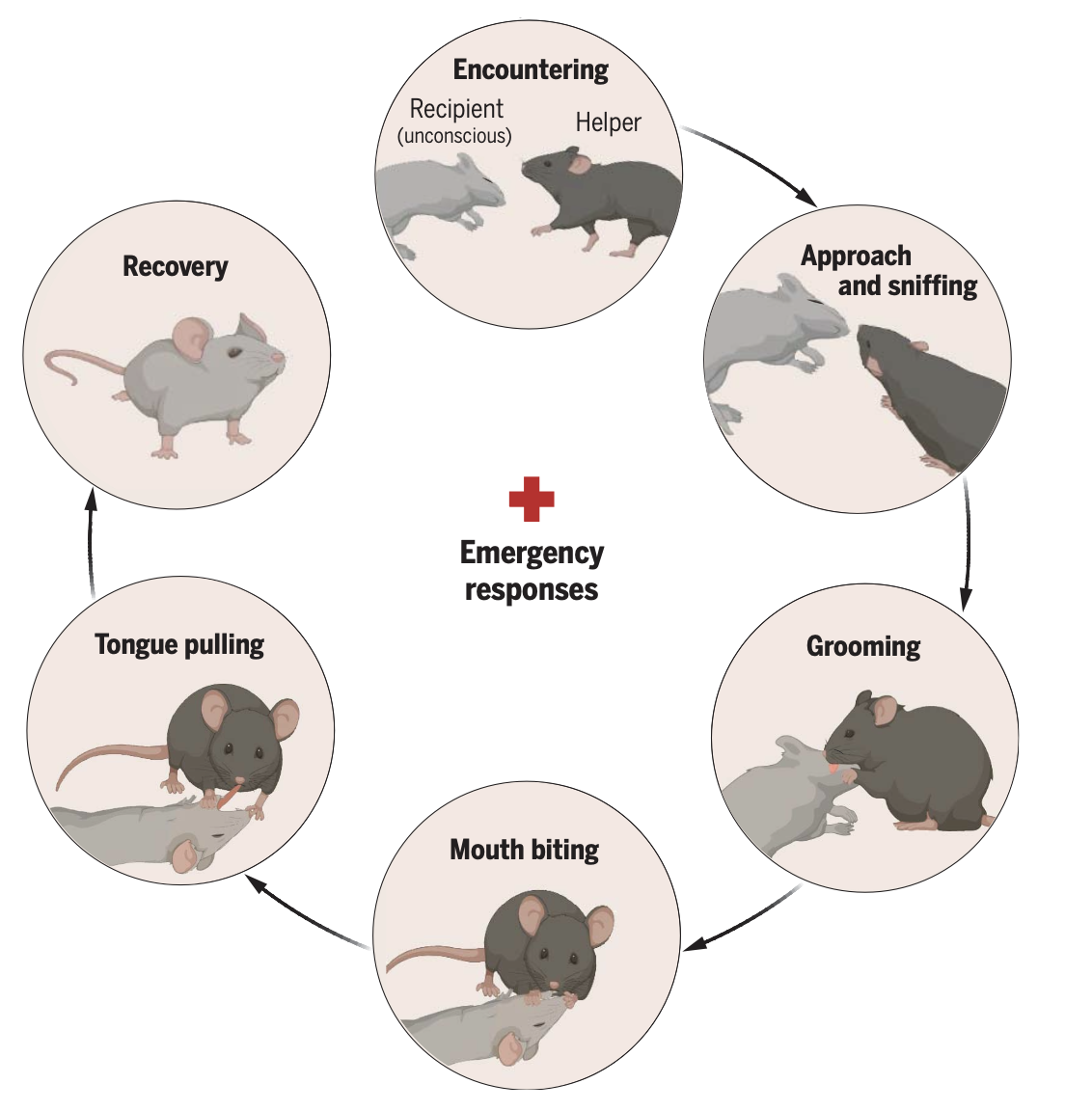
Results indicate that mice exhibit a range of behaviors toward unconscious peers—including sniffing, grooming, and increasingly aggressive actions such as mouth-and-tongue biting and tongue pulling—which intensify over time.
🔥 Stunning Discovery: Mice Have a ‘Rescue’ Instinct
Experimental data shows that mice react very differently to unconscious peers compared to active ones. On average, mice spent 47.4% of their time interacting with unconscious peers, significantly higher than the 5.8% spent engaging with active ones.
Notably, these behaviors are not driven by curiosity or social interaction needs but are triggered upon detecting a peer in an unresponsive state. Interaction ceases immediately once the peer regains consciousness. These actions—including clearing airway obstructions—suggest that mice may be unconsciously engaging in life-saving behavior.
🔬 Deciphering Neural Mechanisms: The Key Role of Oxytocin
Further investigations into neural activity reveal increased activation of oxytocin neurons in the paraventricular nucleus of the hypothalamus when mice encounter unconscious peers.
Using optogenetic technology to either stimulate or suppress these neurons, researchers found that activation enhanced rescue behavior, while suppression reduced such responses—confirming oxytocin’s crucial role in regulating this behavior.
🌍 Sociological Significance: Reshaping Our Understanding of Animal Behavior
This study not only deepens our comprehension of animal behavior but also introduces new perspectives for animal welfare, species conservation, and comparative psychology. The discovery of rescue-like behaviors prompts a reevaluation of animal sociality and emotional experiences.
It suggests that animals may possess far more complex intra-group rescue mechanisms and social behavior patterns than previously assumed—offering valuable clues for exploring animal consciousness and social evolution.
🚀 Unlocking the Future: What Lies Ahead?
The true success of this research lies not only in its ingenious experimental design and rigorous neural investigation—but in its ability to open new doors to how we perceive the animal kingdom.
Animal behaviors are far richer and more intricate than we once imagined. And this discovery is just the tip of the iceberg. As research advances, we may uncover even more secrets behind animal behavior, further deepening our understanding of life’s diversity and complexity.
🔍 Stay curious—because science never stops uncovering the wonders of life!