New RNA-seq Analysis Method - TRADE
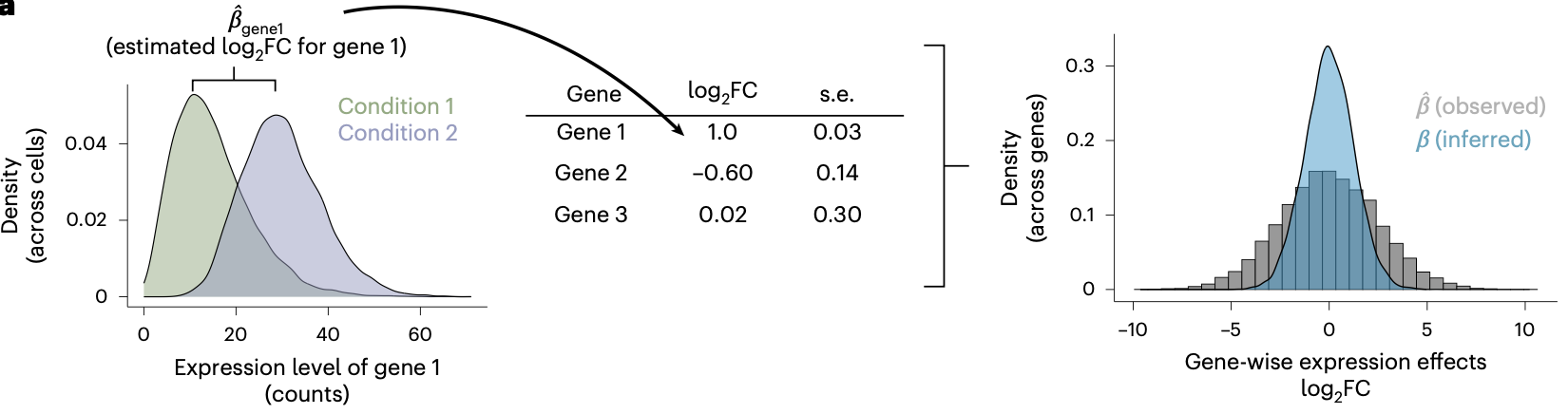
In a recent Nature paper, a novel RNA-seq analysis method was published, which might be the future direction for RNA-seq data analysis.
New RNA-seq Analysis Method - TRADE
🔹 Methodological Innovations
✨ Innovative Modeling Approach
TRADE is a statistical model that directly captures the distribution of differential expression effects. Unlike previous methods that often lack clear estimation objectives or use ambiguous units, TRADE provides a precise quantification of the overall impact of gene perturbation on the transcriptome.
🔗 Integration of Multi-Dimensional Data
By integrating single-cell RNA sequencing data with pseudo-bulk RNA sequencing read count matrices from CRISPR screening experiments, TRADE effectively combines multiple layers of information. It utilizes both differential expression estimates and standard errors to determine the true distribution of expression effects while accounting for estimation errors—enhancing reliability and accuracy.
🔹 Technical Advantages
🎯 Eliminates the Need for Multiple Testing Corrections
TRADE circumvents the statistical power loss typically seen in traditional single-gene testing methods due to multiple testing corrections. This enables a more efficient detection of transcriptome-wide effects, even for small perturbations that conventional analyses might miss.
🔍 Adaptability Across Different Data Characteristics
Whether the effects of gene perturbation are concentrated in a few genes or dispersed across many, TRADE quantifies them effectively using metrics such as the number of differentially expressed genes. This makes it highly suitable for diverse datasets and distribution patterns.
🛠 Stability & Noise Resistance
Through simulations and experimental validation, TRADE demonstrates strong stability across different sample sizes, cell types, and experimental conditions. It also exhibits robust resistance to noise and external interference, ensuring accurate representation of gene perturbation effects.
🔹 Key Findings
🔬 Widespread Impact of Gene Perturbation
Analyzing large Perturb-seq datasets reveals that many transcriptional effects overlooked in standard methods are detectable through TRADE. On average, a typical gene perturbation influences about 45 genes, while an essential gene affects over 500 genes, highlighting a broader transcriptomic impact than traditional analyses suggest.
📌 Consistency Across Cell Types
A moderate level of transcriptional response consistency was observed for gene perturbations across different cell types. However, certain perturbations displayed unique patterns in specific cell types, offering insights into the conserved and specialized functions of genes in different cellular environments.
🧪 Dose Sensitivity Analysis
Through dose-gradient experiments, TRADE uncovers a dose-dependent and nonlinear relationship in transcriptomic responses. Partial depletion of a gene may affect only a few downstream genes, while complete depletion impacts a broader set. Additionally, transcriptional responses at different dose levels exhibit varying correlations—offering crucial insights into gene dosage effects and therapeutic applications.
🧠 Association with Neuropsychiatric Disorders
Reanalysis of differential expression data from postmortem brain tissues of neuropsychiatric disorder patients suggests stronger correlations in transcriptomic effects across different diseases than previously estimated. These correlations also show altered relationships with genetic associations, hinting at shared transcriptomic features and potential common pathological mechanisms in neuropsychiatric disorders.
🔹 Applications
🔍 Gene Function Research
TRADE provides a powerful tool for investigating gene functions by analyzing how gene perturbations influence transcription, revealing key roles and regulatory networks in cellular physiology.
💊 Drug Target Discovery & Evaluation
TRADE helps identify promising drug target genes and evaluates their effectiveness across different cell types and doses, offering valuable insights for drug development and precision medicine.
🏥 Disease Mechanism Exploration
TRADE enhances the study of complex diseases, particularly neuropsychiatric disorders, by uncovering transcriptional dysregulation in disease-associated genes and molecular relationships between different conditions.
🧬 Cell Type Identification & Classification
By serving as a transcriptomic distance metric tool, TRADE facilitates cell type identification, classification, and clustering analysis—advancing single-cell transcriptomics and cell heterogeneity research.
🔗 Gene Regulatory Network Inference
Integrating TRADE results with existing gene regulatory network models enables the inference of global regulatory features and key network nodes, further deepening our understanding of gene expression control.