Single-Nucleus and Spatial Transcriptomics Reveal the Cell Populations of Intercalary Meristems in Bamboo
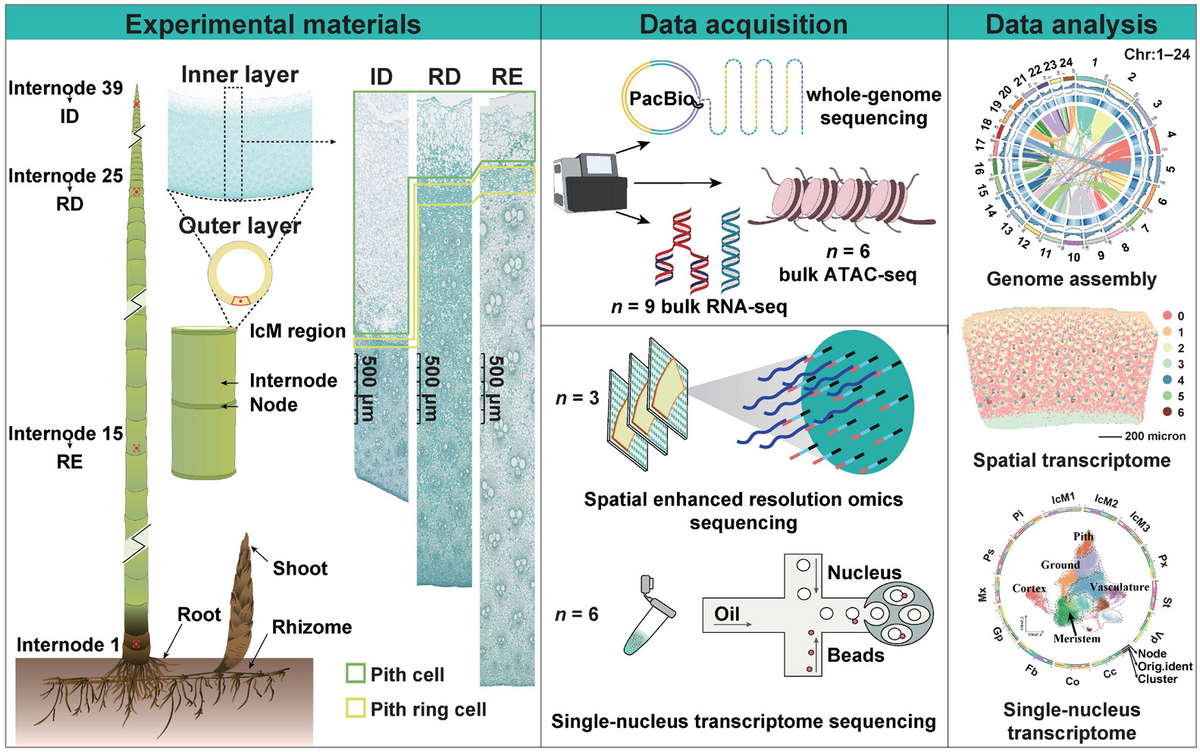
How does the world’s fastest-growing plant shoot up by more than a meter in a single day? The answer lies in the intercalary meristem (IcM)—a specialized growth zone inside the bamboo culm that keeps dividing and elongating for 45–60 days. Yet these cells have been notoriously hard to study: they are transient, deeply embedded in mature tissue, and absent from typical model species. In our latest study published in PNAS, we built the first comprehensive single-cell atlas of the bamboo IcM, revealing its hidden cell populations and the stem-cell machinery behind its explosive growth.
What We Did
Using Moso bamboo (Phyllostachys edulis)—which grows up to 114.5 cm per day—we integrated a chromosome-level genome assembly with single-nucleus RNA sequencing (snRNA-seq), Stereo-seq spatial transcriptomics, ATAC-seq, and high-resolution anatomical imaging across three developmental stages: initial division (ID), rapid division (RD), and rapid elongation (RE).
- 128,370 high-confidence nuclei, 13 distinct single-nucleus clusters (snClusters), covering 96.6% of annotated genes
- Seven spatially defined zones resolved by Stereo-seq, with high concordance with anatomical annotations (Jaccard index = 88.7%)
Key Findings
-
IcM cells are short-columnar cells nestled among ground tissue parenchyma (Gp) cells. Combined spatial transcriptomics, in situ hybridization, and scanning electron microscopy revealed their distinctive morphology: thin cell walls, corner domains, and characteristic wall invaginations.
-
IcM1 is a stem-like subpopulation. Among the three IcM subtypes (IcM1–3), IcM1 showed the highest stemness score (CytoTRACE), expressed stem-cell identity genes including multiple WOX family members, and transcriptionally resembled the procambium-enriched domain (PED) of the shoot apical meristem. Notably, up to 67% of all WOX2 transcripts came from IcM1 cells, which make up only ~15% of the cell population.
-
A WOX2 homolog drives regeneration. Overexpressing clrGene008562 (a WOX2 homolog) in bamboo-derived callus significantly promoted both proliferation and differentiation—pointing to a conserved regulator of cell division and fate determination in the IcM.
-
A bifurcated developmental trajectory. Pseudotime analysis showed IcM1 cells either differentiate into Gp cells (via a transitional state) or mature into a stabilized, undifferentiated state, with distinct co-expression modules (cell-cycle regulators like CDKB2-1 and CYCB1-5 vs. stress/adaptation regulators like ERF and LBD) governing each branch.
Why It Matters
This work provides a molecular and cellular framework for understanding how intercalary meristems drive the extraordinary growth of bamboo—and, more broadly, how monocots regulate rapid stem elongation. The multi-omics resources (including an interactive web atlas: https://db.cngb.org/stomics/datasets/STDS0000377) offer a foundation for improving crop productivity and developing sustainable biomaterials.
Paper: Qin N, Liu X, Li S, Sun L, Chen C, et al. Single-nucleus and spatial transcriptomics reveal the cell populations of intercalary meristems in bamboo. PNAS 2025;122(51):e2511701122. DOI: 10.1073/pnas.2511701122