Single-Nucleus Transcriptomic Atlas Reveals Cellular and Molecular Changes During Epileptogenesis
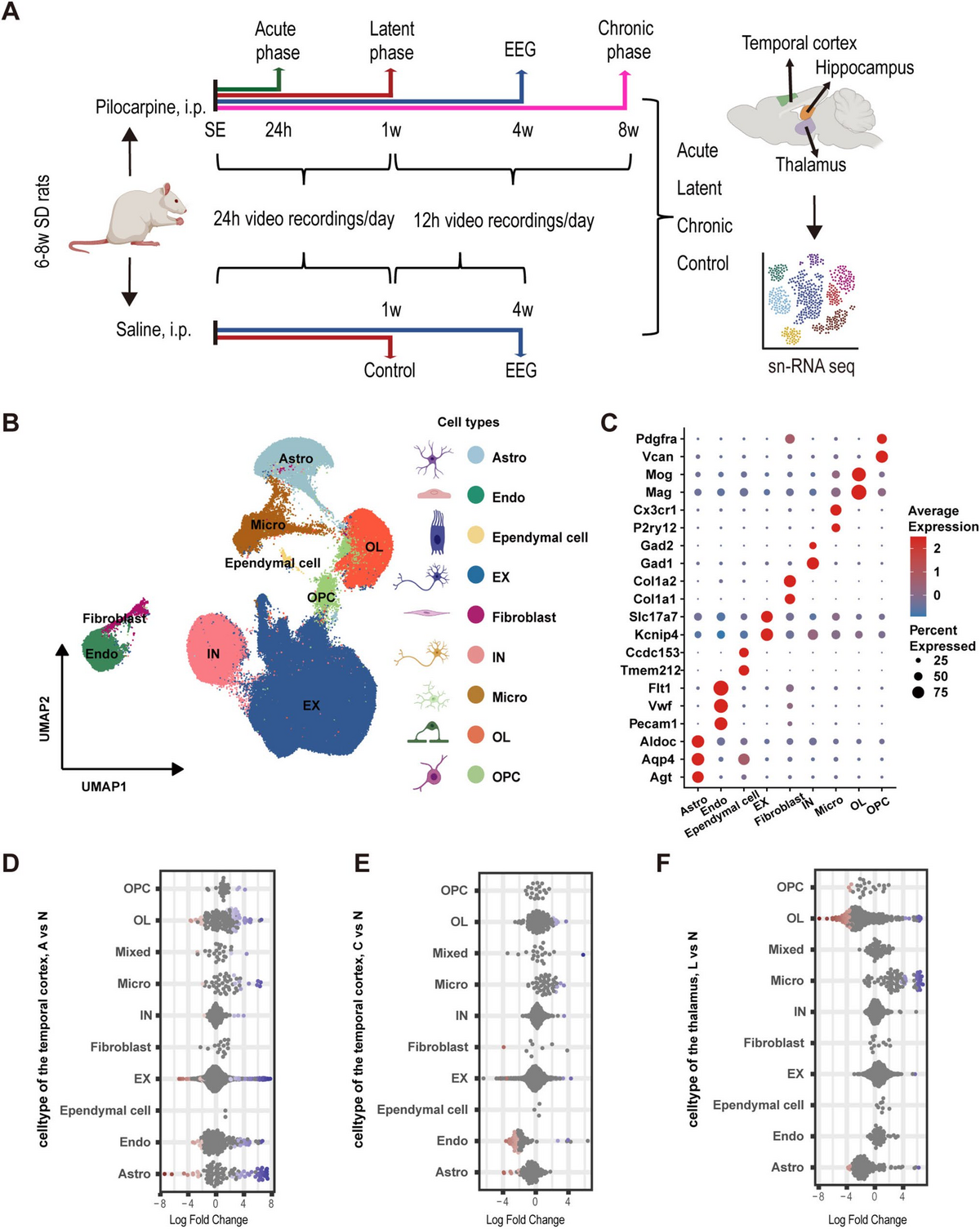
Epilepsy affects about 1% of the global population, and roughly 30% of patients do not achieve complete seizure control with existing antiseizure medications. A major obstacle is that we still do not fully understand epileptogenesis—the process by which a normal brain transforms into an epileptic one. In our latest collaborative study published in Neuroscience Bulletin, we built the most comprehensive single-nucleus transcriptomic atlas of epileptogenesis to date, covering three brain regions across all three phases of the disease.
What We Did
Using single-nucleus RNA sequencing (snRNA-seq), we profiled the hippocampus, temporal cortex, and thalamus in a pilocarpine-induced rat model of temporal lobe epilepsy (TLE) across the acute (24 h), latent (7 d), and chronic (8 w) phases, together with controls. In total, we obtained 311,177 single nuclei from 36 samples and annotated nine major cell types.
Key Findings
-
The acute phase hits the hippocampus hardest. The acute phase showed the highest number of differentially expressed genes (DEGs) across all regions (1,775), with the hippocampus leading (1,007 DEGs)—pointing to intense molecular changes at the onset of epileptogenesis.
-
The latent phase is a hidden window of remodeling in the thalamus. During the latent phase—when no seizures are yet visible—the thalamus displayed the most DEGs (789, with 707 upregulated), enriched in synapse organization and membrane potential regulation. This suggests the latent phase is a critical, and potentially actionable, window for intervention, with the thalamus playing a much greater role than previously appreciated.
-
Two novel astrocyte clusters emerge in the acute phase. Subclustering revealed two astrocyte populations (Cluster 3 and Cluster 9) that expanded specifically in the acute phase across all three brain regions, with the highest abundance in the hippocampus.
-
A specific EX–Astro C3–IN pathway as a potential intervention target. Cell-cell communication analysis uncovered a hippocampus-specific acute-phase cascade: excitatory neurons signal to astrocyte Cluster 3 via SPP1, which in turn signals to inhibitory neurons via EGF. This pathway may contribute to hyperexcitability and represents a promising target for future therapies.
Why It Matters
This dataset provides a detailed temporal and spatial view of epileptogenesis at single-cell resolution, highlighting the latent phase and the thalamus as key targets for early intervention—and offering new molecular entry points to stop epilepsy before it starts.
Paper: Wang Y, Wang Y, Yu F, Liu Y, Liu X, Cai Z. Single-Nucleus Transcriptomic Sequencing Revealed Cellular and Molecular Changes in a Pilocarpine-Induced Epilepsy Rat Model. Neuroscience Bulletin 2026;42(3):539–558. DOI: 10.1007/s12264-025-01451-y