Integrated Multi-Omics Decipher the Complex Nodule Microbiota and Distinct Frankiaceae Symbiotic Traits in Wild Actinorhizal Plants
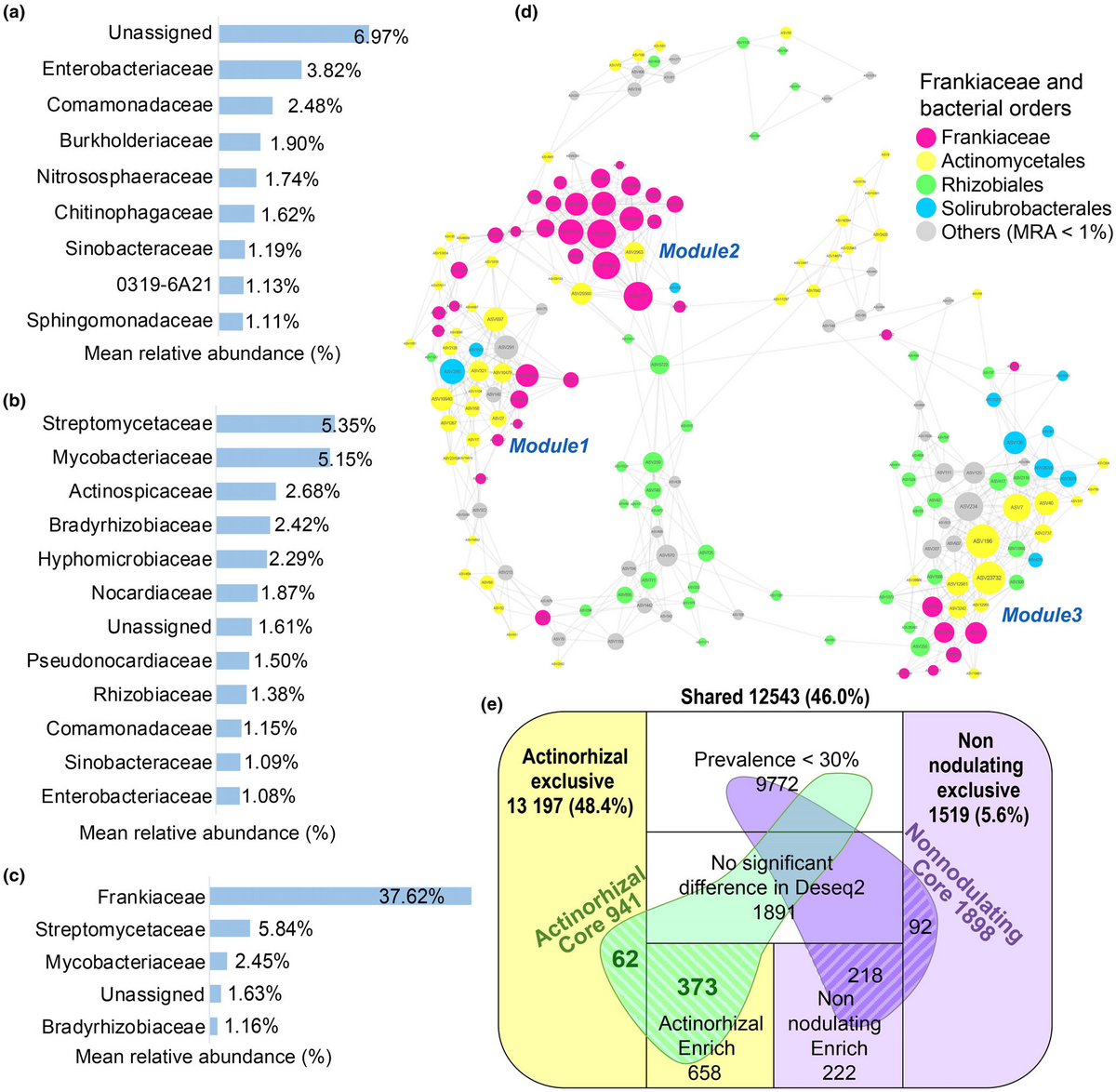
Actinorhizal plants—woody pioneers of temperate ecosystems—form nitrogen-fixing root nodules with Frankiaceae bacteria, contributing roughly 25% of terrestrial biological nitrogen input. Yet compared with the well-studied legume–rhizobia symbiosis, their root-associated microbiomes have remained largely uncharted. In our latest study published in New Phytologist, we integrated 16S amplicon, transcriptomic, and metagenomic data across wild actinorhizal plants, legumes, and non-nodulating relatives to reveal how these symbioses are assembled—and how they differ fundamentally from legumes.
What We Did
We profiled the prokaryotic communities in the rhizosphere, root, and nodule compartments of five phylogenetically representative actinorhizal species (spanning all three actinorhizal orders), three legumes, and four non-nodulating nitrogen-fixing-clade (NFC) species using 16S rDNA sequencing. We then performed transcriptomic analysis on actinorhizal roots and metagenomic analysis on nodules, recovering four novel Frankiaceae species from metagenome-assembled genomes (MAGs).
Key Findings
-
Frankiae rarely dominate nodules. Unlike rhizobia in legume nodules (typically >95% relative abundance), Frankiaceae abundance in actinorhizal nodules fluctuated and rarely exceeded 90%—evidence of a “looser,” less intimate symbiosis.
-
Nodules harbour a diverse, positively interacting microbial consortium. Actinorhizal nodules contain many non-Frankiaceae bacteria (43 families), with 85.8% of microbial correlations being positive. Frankiae formed a tightly interconnected subgroup (Module 2), alongside other functional players such as Streptomycetaceae and Solirubrobacterales—the latter reported in actinorhizal nodules for the first time.
-
Actinorhizal plants actively recruit a specialized rhizosphere community. They enrich beneficial microbes, notably ammonia-oxidising archaea (Nitrososphaeraceae), which may accelerate nitrogen cycling in nutrient-poor soils—matching the pioneer lifestyle of these plants.
-
A conserved symbiotic toolkit, with a twist. 110 of 203 validated legume RNS genes were ubiquitously expressed across actinorhizal orders, including the entire common symbiosis signalling pathway. Notably, a nearly complete phosphoinositide (PI) signalling module correlated with Frankiaceae abundance, suggesting PI signalling functions in actinorhizal symbiotic signal transduction.
-
Frankiaceae differ fundamentally from rhizobia in symbiotic function. Their less intimate symbiosis may favour the life-history strategies of temperate perennial actinorhizal plants, with implications for understanding the evolution of nitrogen-fixing symbioses.
Why It Matters
This work provides the first comprehensive multi-omics view of actinorhizal nodule microbiomes, highlights both conserved and divergent features of nitrogen-fixing symbioses, and offers new resources—including novel Frankiaceae genomes—for studying and potentially engineering nitrogen-fixing associations.
Paper: Luo X, Lei Z, Fang D, Chen H, Qian L, Jin C, Wang X, Liu X, Liu H, Wang Y. Integrated multi-omics decipher the complex nodule microbiota and distinct Frankiaceae symbiotic traits in wild actinorhizal plants. New Phytologist 2026;251:2832–2851. DOI: 10.1111/nph.71234