Foxtail Millet Genome Sequencing: Insights into Grass Evolution and Biofuel Potential
Foxtail millet (Setaria italica) is a drought-tolerant crop with rich nutritional value and historical significance, domesticated in China over 8,700 years ago. As one of the most resilient cereal grains, it serves as a model for biofuel research and plant evolution studies. Despite its economic and ecological importance, a comprehensive genome reference had been lacking. In our latest study, published in Nature Biotechnology, we present the first high-quality genome assembly of foxtail millet, uncovering key genetic traits linked to chromosomal evolution, drought adaptation, and biofuel potential.
Key Findings
- Genome Assembly and Annotation:
- The 423 Mb draft genome was successfully anchored onto nine chromosomes, covering approximately 86% of the estimated genome size.
- A total of 38,801 protein-coding genes were identified, with 81% showing expression activity across different tissues.
- Evolutionary Insights and Chromosomal Rearrangements:
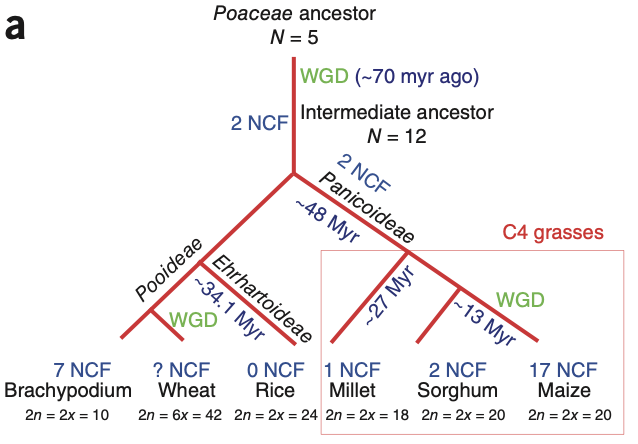
- Comparative genomic analysis with rice and sorghum revealed three major chromosomal reshuffling events, highlighting key divergence points in grass evolution.
- Foxtail millet was found to share an ancestral whole-genome duplication (WGD) event dating ~70 million years ago, before its split from sorghum and maize.
- Functional Genomics and Key Trait Mapping:
- Genes related to C4 photosynthesis, an efficient carbon fixation pathway, were studied, providing insight into its role in enhancing drought resistance and biomass productivity.
- Sethoxydim-resistance mapping successfully pinpointed genetic variations linked to herbicide tolerance, reinforcing foxtail millet’s potential for sustainable agriculture.
Reflections
BGI’s agricultural research division has long recognized foxtail millet as an essential model crop, not only because it was domesticated in China and remains widely cultivated here, but also because of its exceptional drought tolerance and nutritional advantages. While its lower yield has historically limited commercial expansion, its genetic traits hold tremendous potential for biofuel applications and stress-resilient crop development.
This study represents an important milestone in plant genome research, marking the successful construction of a foxtail millet reference genome and trait mapping analysis. Our research team worked in parallel with an international group, and both studies on foxtail millet genomics were published simultaneously. By integrating high-throughput sequencing technologies with applied genomics, we aim to accelerate crop improvement, conservation, and sustainability efforts.
The full text of this study can be accessed online at Nature Biotechnology.