African Arowana Genome Provides Insights into Ancient Teleost Evolution
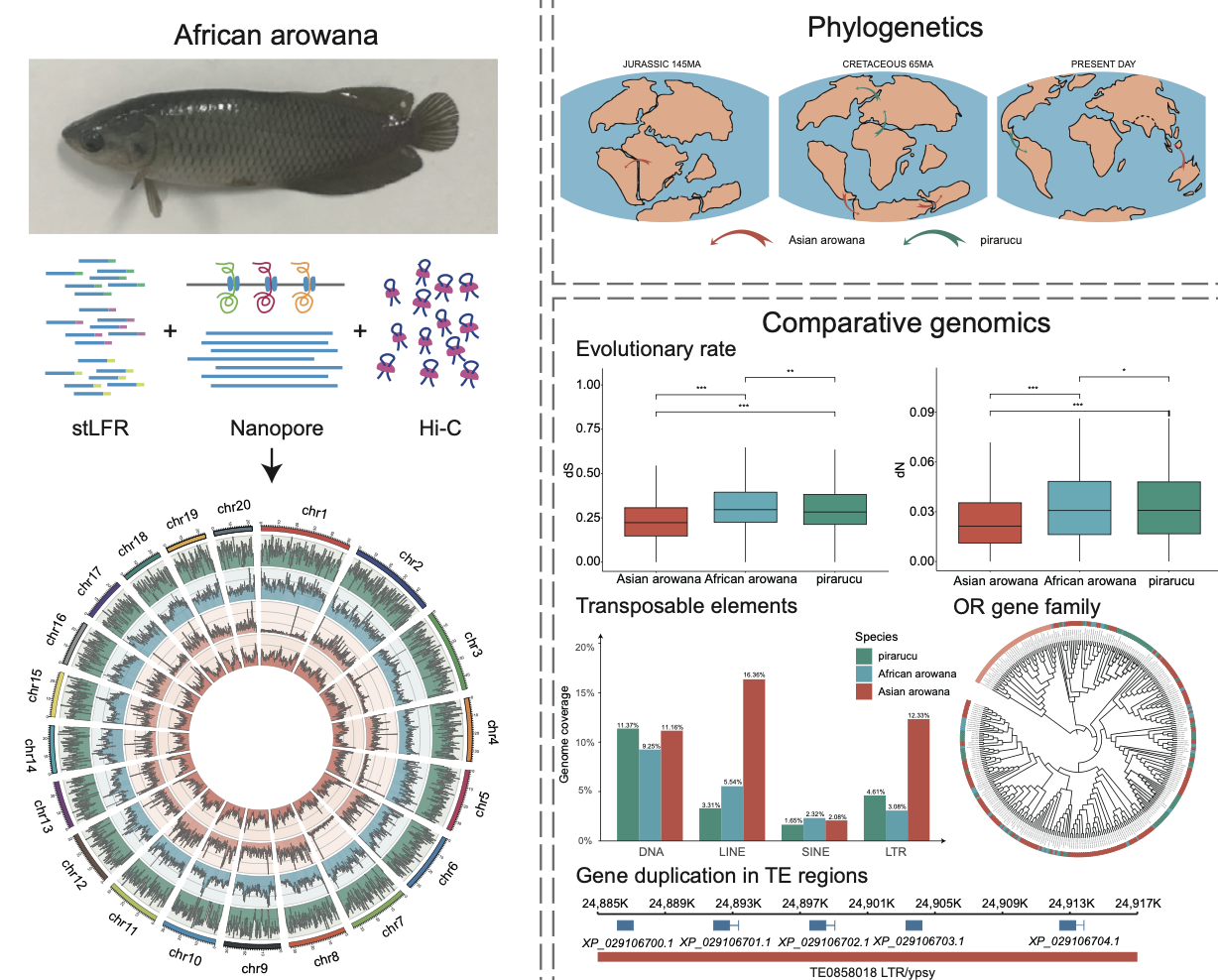
The evolutionary history of teleosts is deeply intertwined with continental drift, shaping their genetic diversity and adaptations. In our latest study, published in iScience, we present a chromosome-level genome assembly of the African arowana (Heterotis niloticus), alongside comparative analyses with its relatives, the pirarucu (Arapaima gigas) and Asian arowana (Scleropages formosus). This work provides critical insights into the genomic evolution of Osteoglossidae and the impact of biogeographical events on teleost diversification.
Key Findings
-
Genome Assembly and Evolutionary Insights:
Utilizing stLFR, Nanopore, and Hi-C sequencing, we achieved a highly contiguous genome assembly of 669 Mb, anchored to 20 chromosomes. Phylogenetic analysis revealed that African arowana diverged from Asian arowana ~106.1 million years ago, coinciding with the final separation of Africa and South America. -
Dynamic Genome Evolution:
African arowana exhibited a faster evolutionary rate and higher pseudogenization compared to Asian arowana, reflecting its adaptation to new ecological niches. Additionally, we observed more transposable element insertions in Asian arowana, contributing to gene duplications and genome expansion. -
Genetic Mechanisms Underlying Dietary Transition:
Unlike its carnivorous relatives, the African arowana transitioned to an omnivorous diet, with a noticeable contraction of olfactory receptor genes and expansion of UGT genes involved in metabolism—suggesting genomic adaptations linked to feeding behavior changes.
Reflections
This project was part of our broader genomic research on Osteoglossiformes and was conducted in collaboration with Professor Li-Zhi Gao and our team members, including Xin Liu, who contributed extensively to data analysis and interpretation. Given the economic and ecological significance of arowana species, this study provides valuable genomic resources for both evolutionary biology and aquaculture improvements.
Through long-term collaborations and advanced sequencing techniques, we continue to uncover the genetic basis of teleost adaptation, speciation, and evolutionary history. As we expand our work in fish genomics, we aim to integrate comparative genomics with functional studies, further exploring the molecular evolution of aquatic species.
The full text of this study can be accessed online at iScience.