Unveiling the Genetic Diversity of Moso Bamboo: A Population Genomics Study
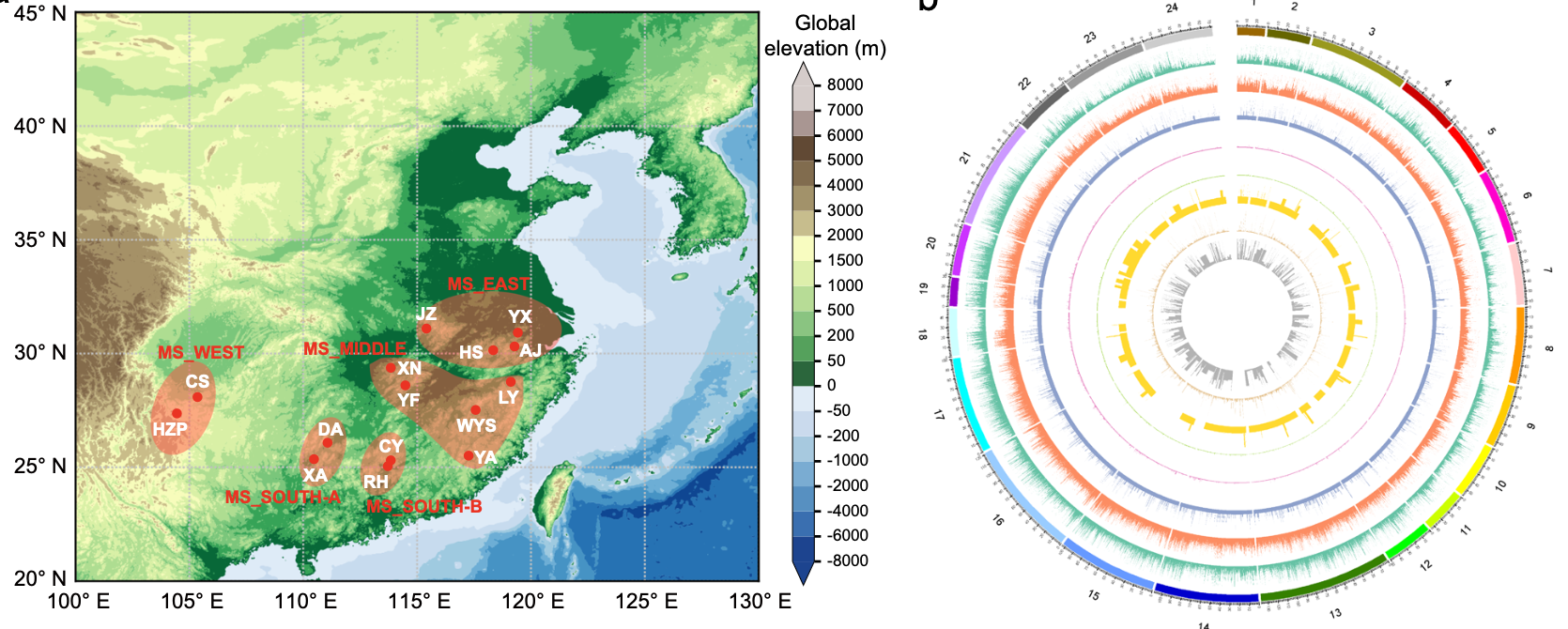
Bamboo has been an integral part of Chinese culture and daily life for centuries, serving not only as an essential natural resource but also as a deep cultural symbol. Moso bamboo (Phyllostachys edulis), in particular, stands as the most widely cultivated bamboo species, covering vast landscapes and playing a crucial role in ecological and economic sustainability. In our recent study published in Nature Communications, we conducted whole-genome resequencing of 427 moso bamboo individuals from across China, providing the most comprehensive insight into bamboo genetic diversity, population structure, and evolutionary history to date.
Key Findings
-
Genomic Diversity and Population Structure:
Despite its widespread cultivation, our study uncovered low genetic diversity in moso bamboo alongside notably high genotype heterozygosity. We identified five phylogenetic groups, suggesting distinct evolutionary pathways shaped by environmental adaptation and historical bottlenecks. -
Environmental Adaptations and Balancing Selection:
Many genes in the moso bamboo genome appear to have undergone balancing selection, particularly those involved in oxidative stress responses, pathogen defense, and growth regulation. These findings provide insights into how moso bamboo has successfully adapted to environmental pressures over time. -
Genomic Contributions to Agronomic Traits:
Using genome-wide association analysis, we linked genetic variations to nine important traits, including stem strength, density, and elasticity—features that determine bamboo’s mechanical properties and agricultural applications. Many of the candidate genes identified are involved in cell wall formation, carbohydrate metabolism, and stress resilience, offering valuable genetic markers for future breeding programs.
Reflections
This study marks my first direct involvement in bamboo research, an area that has long fascinated me. Previously, we had announced the Bamboo and Rattan Genome Project, but this research represents our first deep genomic exploration of bamboo populations. As someone who grew up in rural Southwest China, bamboo has always been an inseparable part of my life—from childhood games of climbing bamboo stalks and crafting toys out of bamboo, to seeing my grandfather skillfully weave bamboo tools. It was a material that shaped both daily life and childhood adventures.
With China’s rapid industrialization, many traditional bamboo applications have diminished, replaced by modern alternatives like plastic and metal. However, as I discussed this research with collaborators, vivid memories of my childhood resurfaced—a summer noon spent under the shade of a bamboo grove, or watching my grandparents use bamboo sheaths to wrap dumplings during the Dragon Boat Festival. These moments of nostalgia remind me that our work is not just about genomes and sequences; it is also about preserving the cultural legacy and ecological significance of bamboo. Through this research, I hope we can bridge the past and the future, ensuring that bamboo remains a valuable part of scientific exploration and cultural identity.
The full text of this study can be accessed online at Nature Communications.