Lamprey Cell Atlas Study Reveals Natterin's Role in Fat Browning
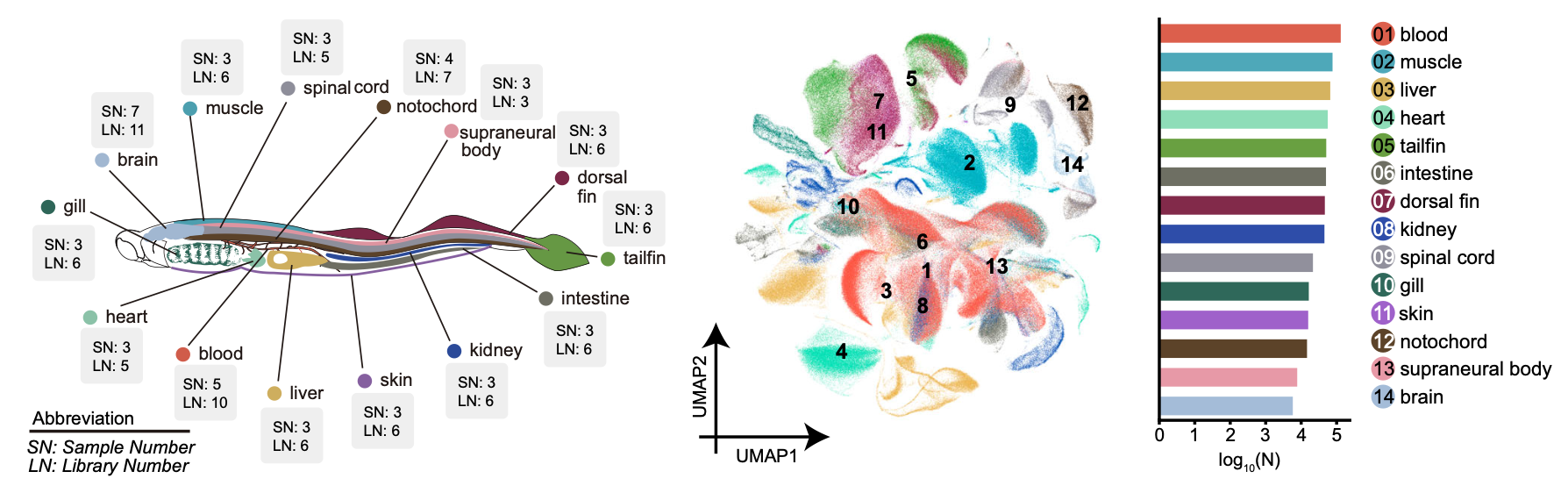
A study co-led by Xin Liu (BGI Research / XinLab), Guangyi Fan (BGI Research), Qingwei Li (Liaoning Normal University), and Yue Pang (Liaoning Normal University), published in Nature Communications, presents a comprehensive single-cell atlas of the lamprey (Lethenteron reissneri), offering profound insights into vertebrate evolution and uncovering a novel function for the immune protein Natterin in regulating fat metabolism.
Why Lampreys?
Lampreys, ancient jawless vertebrates, hold a unique evolutionary position linking invertebrates and jawed vertebrates. Understanding their cellular makeup is key to deciphering vertebrate evolution, but a lack of detailed multi-organ cell atlases has been a major hurdle.
Building the Atlas: A Single-Cell Approach
The research team, with significant contributions from XinLab, generated a vast single-cell and single-nucleus transcriptome atlas:
- Scope: Covered 14 different tissues from lamprey larvae.
- Scale: Profiled ~604,460 cells/nuclei.
- Resolution: Identified 70 distinct cell types.
This atlas provides an unprecedented high-resolution map of lamprey cellular diversity.
Key Discoveries & Insights
- Vertebrate Evolution:
- Cross-species comparison revealed that most lamprey cell types have homologous counterparts in jawed vertebrates (like mice and humans), shedding light on shared ancestry.
- Despite lacking a distinct pancreas, lampreys possess islet-like and acinar-like cells within their intestines, suggesting the evolutionary origins of pancreatic function.
- Lamprey Immunity:
- The atlas characterized diverse immune cell populations, including VLR cells (homologous to T/B cells) and distinct granulocyte subtypes.
- Natterin’s Novel Role in Metabolism:
- The immune protein Natterin was found highly expressed in lamprey granulocytes and localized to lipid droplets.
- Crucially, expressing lamprey Natterin in a transgenic mouse model led to the browning of white adipose tissue (WAT) – converting fat-storing cells into metabolically active, heat-generating cells.
- This Natterin-induced browning increased thermogenesis and resulted in significant weight loss in obese mice, comparable to the effect of the weight-loss drug Orlistat, without apparent short-term or long-term toxicity at effective doses.
- Mechanism: The study suggests Natterin interacts with the transferrin receptor (TFR1), potentially mediating iron accumulation in WAT cells, which triggers lipolysis, mitochondrial proliferation, and ultimately, WAT browning.
Significance & Future Directions
This research, co-led by XinLab, delivers a vital resource for evolutionary biology and comparative genomics. It significantly advances our understanding of vertebrate cellular origins and lamprey immunity. Furthermore, the discovery of Natterin’s potent effect on WAT browning opens exciting new avenues for exploring therapeutic strategies against obesity and metabolic disorders.
Reference: Pang, Y., Qin, Y., Du, Z. et al. Single-cell transcriptome atlas of lamprey exploring Natterin-induced white adipose tissue browning. Nat Commun 16, 752 (2025). https://doi.org/10.1038/s41467-025-56153-w
Data Availability: Data are available via the CNGB Nucleotide Sequence Archive (CNP0005120) and NCBI BioProject (PRJNA1194219). An interactive portal is available at https://db.cngb.org/search/project/CNP0005120/.