New Paper Unveils Spatiotemporal Atlas of Mouse Heart Development
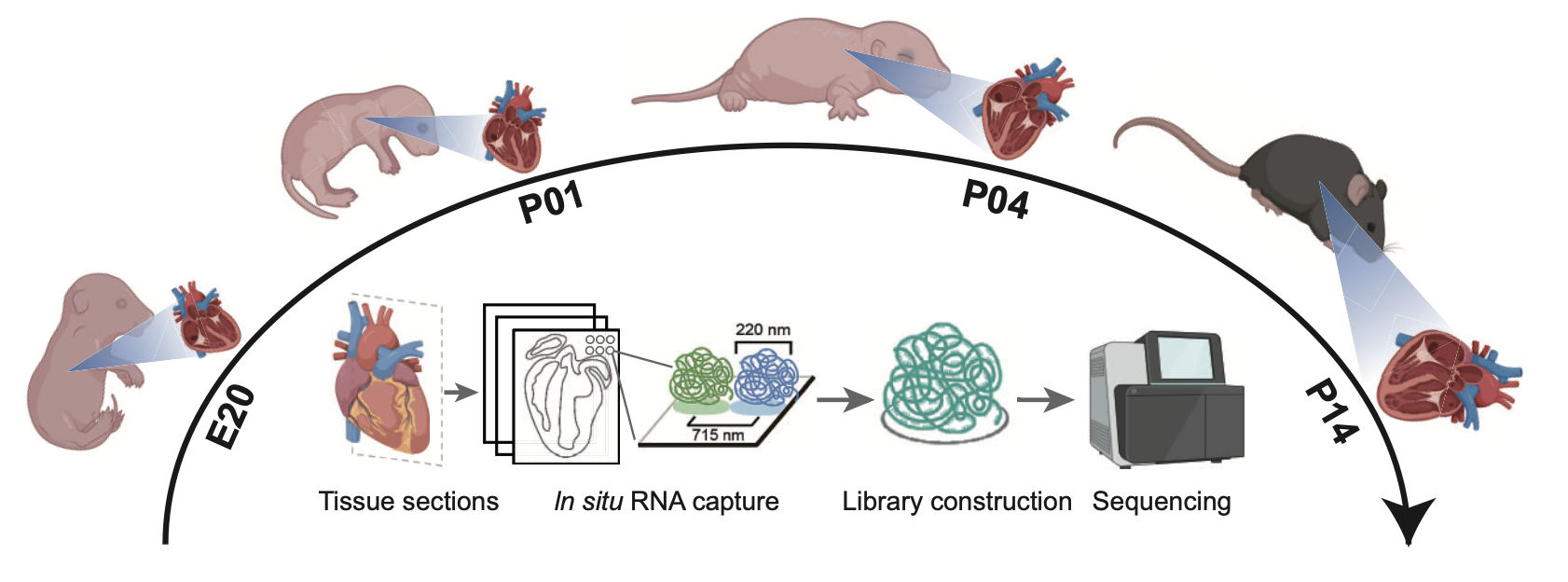
We’re thrilled to announce that XinLab has published a new paper in GigaScience (2025, Vol. 14) titled “Exploring the Cellular and Molecular Basis of Murine Cardiac Development through Spatiotemporal Transcriptome Sequencing.” Led by Xin Liu and Jizheng Wang, with contributions from Jingmin Kang, Qingsong Li, and others, this study marks a significant step forward in understanding heart development and regeneration.
Why It Matters
The heart is a complex organ, and unlocking the secrets of its development could pave the way for new treatments for heart disease. Mice are unique because their hearts can regenerate shortly after birth, unlike humans. By studying this process, we aim to uncover mechanisms that could one day inspire regenerative therapies. Our study uses cutting-edge Stereo-seq technology to map gene expression across developing mouse hearts, revealing how cells and molecules change over time.
Key Findings
Using spatial transcriptomics, we created a comprehensive atlas of mouse heart development at four time points: embryonic day 20 (E20), postnatal day 1 (P01), day 4 (P04), and day 14 (P14). Here’s what we discovered:
- Cellular Landscape: Identified 14 distinct cell types, with ventricular cardiomyocytes (57%) and atrial cardiomyocytes (21%) dominating. Over time, ventricular cells increased, while atrial cells and fibroblasts decreased.
- Cell Interactions: Found that cell-cell interactions weaken as the heart matures, linked to reduced signals like collagen and insulin-like growth factor, potentially tied to loss of regeneration.
- Regeneration Insights: Pinpointed genes like Igf2 and transcription factor Plagl1 as key players in early heart regeneration, validated by quantitative PCR. These could be targets for future research.
- Atrial Asymmetry: Uncovered genes like Pitx2 and Bmp10 driving left-right atrial differences, critical for heart function.
The XinLab Connection
This study reflects XinLab’s mission to push the boundaries of computational biology and cardiology. Xin Liu, the study’s senior author, guided the team in leveraging spatial omics to map the heart’s molecular dynamics. Jingmin Kang and Qingsong Li played pivotal roles in data analysis and experiments, collaborating with experts like Jizheng Wang from Fuwai Hospital. Check out our People page to meet the full team behind this work!
Dive Deeper
- Read the Paper: Access the full study in GigaScience here.
- Explore the Data: Raw data is available at NCBI SRA (PRJNA1148773), processed data at CNGBdb (5170000062), and supporting materials at GigaDB (10.5524/102645).
- Learn More: See how Stereo-seq works in this Cell paper.
What’s Next?
This atlas is a foundation for future studies on heart regeneration and disease. We’re already exploring new time points and functional validations to build on these findings. Stay tuned for updates, and join us in unraveling the heart’s mysteries!
Published on April 11, 2025, by XinLab